Research
Active composites, and what you can build with them
Most of our work starts with a polymer filled with particles that respond to a field. The questions are how to arrange the particles, how to predict what the result will do, and what to make with it.
-
Multifield processing
NSF CMMI-1762188
Applying a magnetic field and an electric field to a composite while it cures lets us set hierarchical particle arrangements, such as chains aligned in one direction and another structure at a different scale. The same ingredients then give different properties from one region to the next.
We measure the resulting microstructures, predict properties computationally, and optimize the processing conditions to hit a target.
Masud et al. 2023 · Widdowson et al. 2022, 2026 · Papula et al. 2021
-
Optimized magnetoactive actuators
Magnetoactive elastomers deform when a field is applied, but the shape that works best is rarely obvious. We use coupled magnetoelastic topology optimization to design actuators, print them by direct ink writing, and test how closely they follow the model.
Current undergraduate work in COMSOL combines optimized deformation modes into space-filling structures.
Bergen et al. 2024, 2025 · Zamani et al. 2025
-
Magnetic 3D printing and patterning
Ferromagnetic powders mixed into elastomers and printable filaments can store magnetic patterns that read like a bar code, or act as sensors inside a printed part. The lab continues this work with new mixtures and printing processes.
Breznak and von Lockette 2018 · Watson and von Lockette 2018
-
Cardiac and surgical devices
A magnetically driven peristaltic pump moves blood with less damage to red cells. A multiply-bistable mechanism is being developed as an assistive device for single-ventricle heart defects. With Penn State collaborators we designed a laparoscopic surgical system that moves freely through a single incision, now covered by a U.S. patent.
Momenzadeh and von Lockette 2021, 2022 · Galvin et al. 2022, 2023
-
Bio-inspired design
NSF IRES iPRISM
Climbing plants such as Smilax aspera adapt their stems to the loads they carry. Undergraduate researchers use micro-CT and image analysis to measure how fibers are arranged, and we work with collaborators in Freiburg and Hamburg to turn those patterns into design rules for reinforced structures. A related project models hygroscopic actuators that move as they take up moisture.
-
Origami and compliant mechanisms
Earlier work paired magnetic actuation with folded and bistable structures, including Miura-Ori sheets, waterbomb bases and bistable compliant mechanisms, with collaborators at Penn State.
Cowan and von Lockette 2017 · Crivaro et al. 2015
Fields set the arrangement
Particle dynamics simulations of 100 particles in a representative volume, under five processing conditions. An electric field alone pulls the particles into long chains along the field. A magnetic field orders them into stacked arrangements, and when both fields are applied it dominates. The resulting structures are then homogenized to predict the composite's stiffness and permittivity.
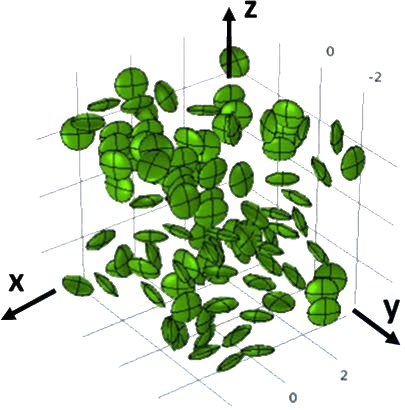
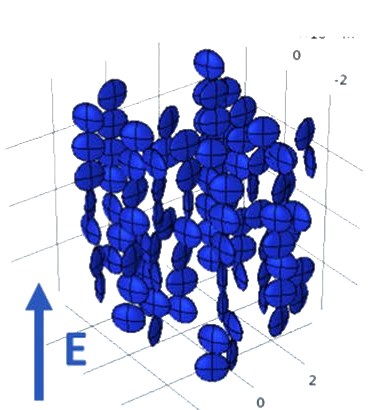
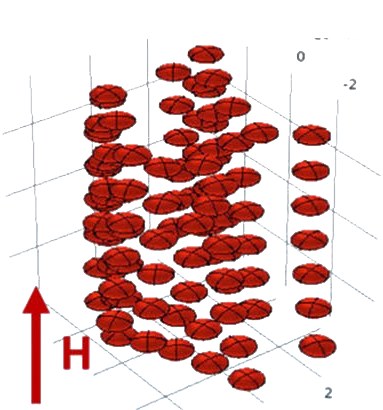
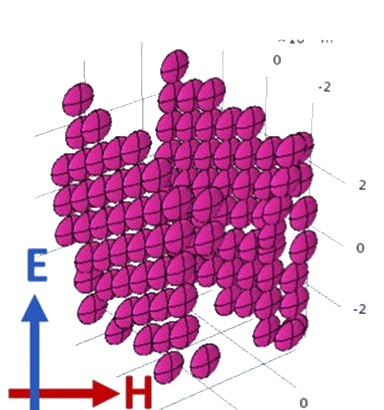
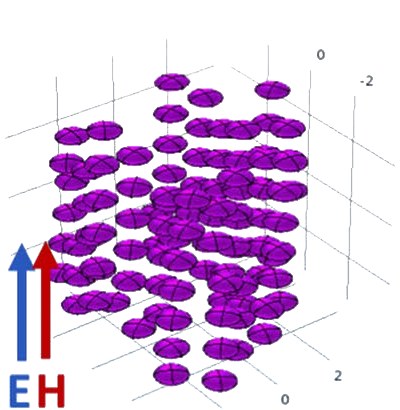
From Widdowson, Papula, Erol, Ounaies and von Lockette, “A computational homogenization framework for predicting properties from multifield processing conditions in polymer matrix particle composites,” Integrating Materials and Manufacturing Innovation 15, 259–274 (2026), Fig. 2, cropped into separate panels with the background lightened. Open access under CC BY 4.0. doi:10.1007/s40192-026-00458-1
The ideas, drawn
Three length scales
Particle interactions set what the material does, internal architecture steers it, and the device is rated against its job.
Hard and soft magnetization
A hard magnetic particle brings its own magnetization. A soft one only responds. The difference changes how a device moves.
Torque on a particle
A particle that is not round turns toward the field. Many small turns add up to bending and shear in the whole composite.
Aligned is not always magnetized alike
Physical alignment of particles and the alignment of their magnetization can differ, so both have to be measured.
Coupled optimization
Designs that treat the field and the deformation together can move a load with less material and less energy.
A printed cube that turns itself
To lower its magnetic energy, a 3D printed iron-PLA cube tries to line its infill up with a uniform field.
Universal printing
One ink, many properties. Electromagnetic fields during printing arrange particles in the silicone in different ways.
Peristaltic pumping
A stronger driving field pumps more volume, and efficiency shows an intermediate peak. The pump's magnetic architecture can be tuned to it.
Bending, put to work
Magnetically induced bending drives accordions, walkers, grippers and pumps, from about 50 to 100 millimeters long.
Where the energy goes
In the hexaflexagon test, 17.3 N·mm of magnetic energy became 8.07 N·mm of stored elastic energy.
Printing, then checking
Ink recipes and print settings are judged with automated image-processing metrics before the unit cells are tested in a field.
What the optimizer found
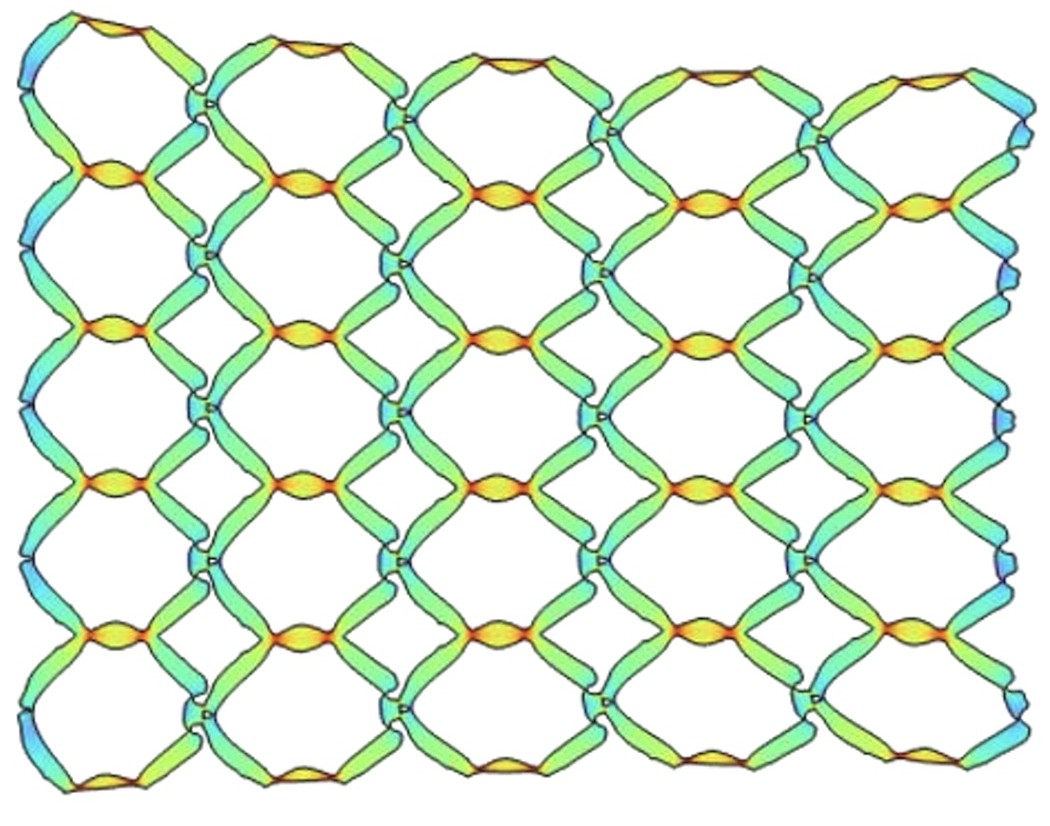
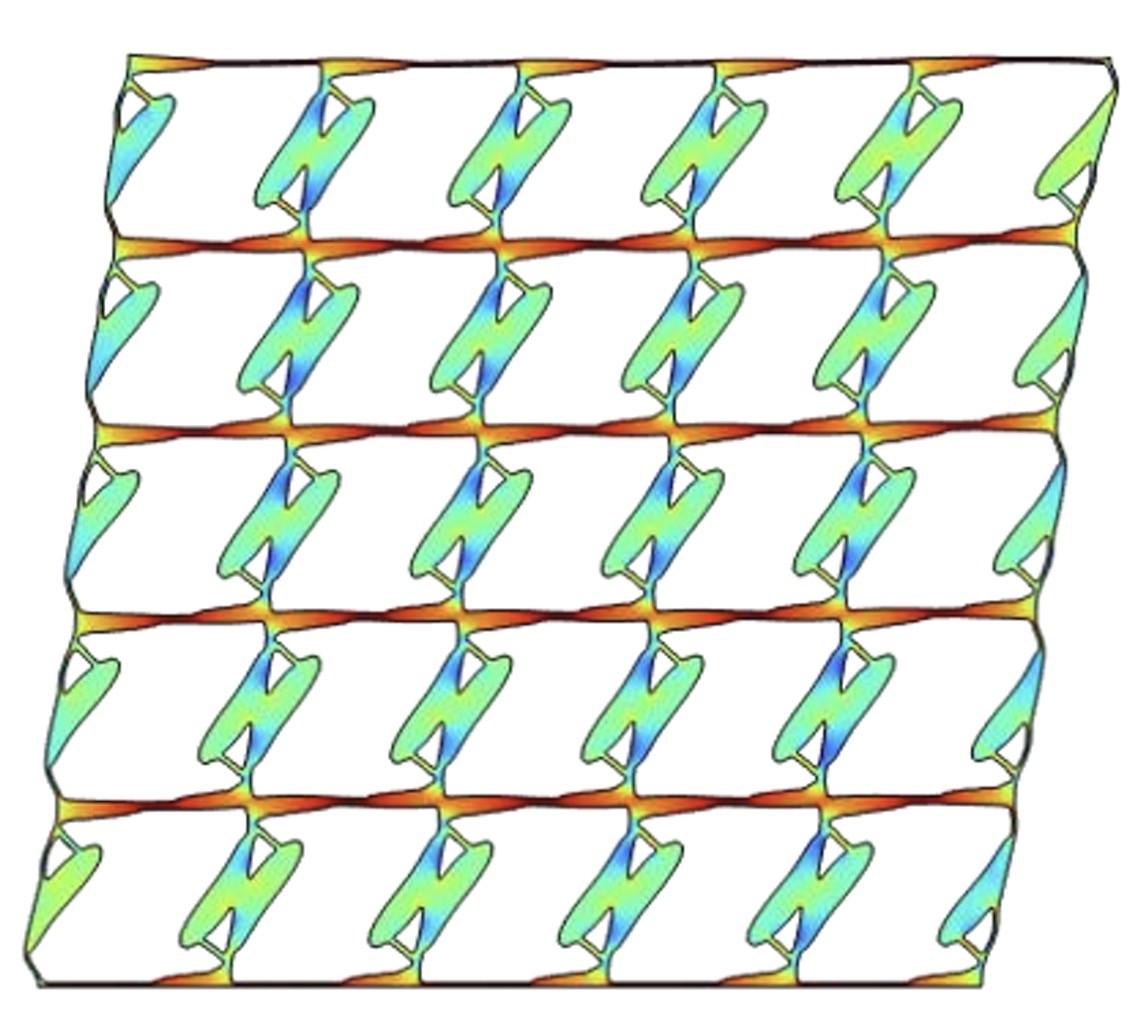
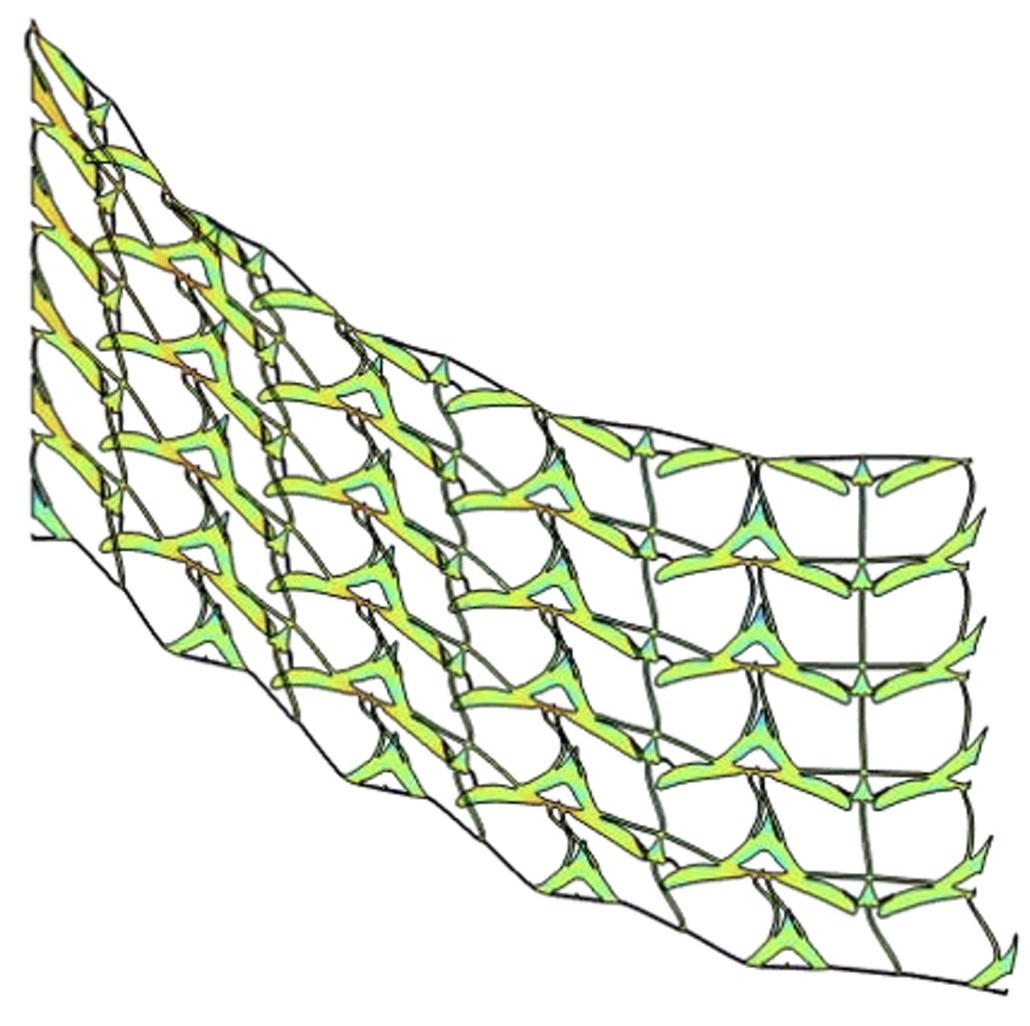
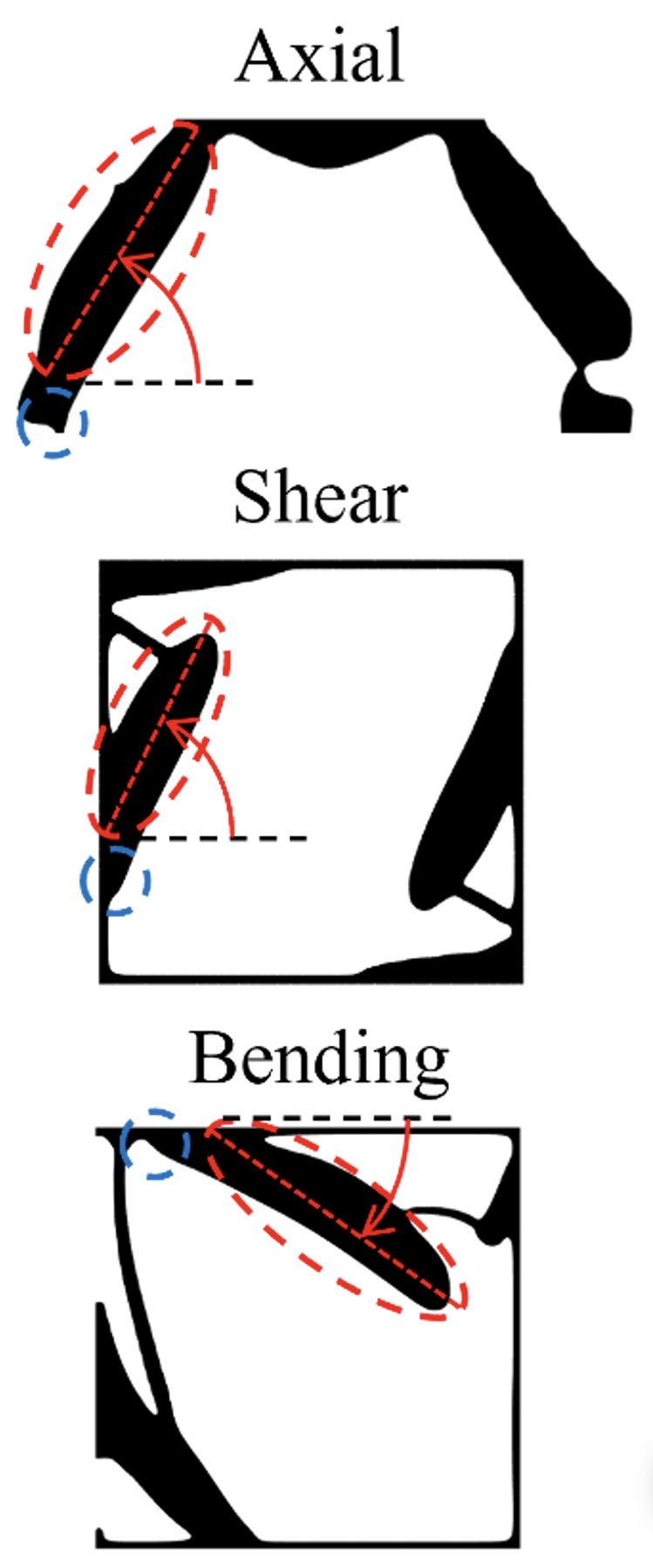
Coupled magnetoelastic topology optimization of a magnetoactive elastomer unit cell, run for three target motions. Each optimized cell is tiled into a 5 × 5 pattern and shown deformed under an applied field. Color shows the magnetic energy density, from blue (low) to red (high).
The curious shapes
All three optimized cells, though designed for different motions, arrived at the same mechanism: an elongated, angled element (outlined in red) that rotates about a thin flexure (circled in blue).
The field tries to turn the elongated element into alignment, and the flexure acts as a hinge that lets it rotate while storing elastic energy. Bergen captured this with an analytical ellipsoid-spring model, a soft-magnetic ellipsoid on a torsional spring, and measured each element's angle to the applied field (dashed line).
Because the same shape keeps appearing, it points toward general design rules for magnetic soft actuators.
From C. Bergen, Topology Optimization and Additive Manufacturing of Magnetoactive Elastomer Actuators, PhD dissertation, Penn State, 2026. Used with his permission.
Funding
- NSF OISE-21536352022–2026 · Co-PI
IRES Track I: International Partnership for Responsive Infrastructure using Sustainable Multifunctional Materials (iPRISM).
- NSF CMMI-17621882018–2023 · PI
Multi-material properties via multi-field processing on a single constituent set, with REU, data science and INTERN supplements.
- ROCKET Seed Grant2020–2021 · PI
A magneto-elastic peristalsis pump for reduction of hemolysis. Penn State College of Engineering.